Complete Guide to Buying Washing Machines in India (2026)
· 14 min read · Washing Machines
Front-load vs top-load, semi-automatic vs fully-automatic, inverter motors, capacity, star ratings — everything you need to choose a washing machine that survives real Indian laundry for a decade.
A washing machine is a 8–10 year purchase, and the wrong choice means either daily frustration (too small, slow, rough on clothes) or wasted money (too big, too premium for your needs). This guide breaks down every decision an Indian household actually faces — capacity, load type, motor technology, energy rating, drum material, wash programs and price — so you buy once and buy right.
1. Capacity: match the drum to your household, not your ambition
Capacity (in kilograms of dry laundry) is the single most important spec, and Indian buyers routinely get it wrong by oversizing. A 9 kg machine for a couple wastes water and power on every half-load; a 6 kg machine for a family of five means running three cycles on Sunday. Use this rule of thumb: 1–2 people → 6 kg, 3–4 people → 7 kg, 4–5 people → 8 kg, 6+ people or heavy bedding → 9 kg and above. Remember that capacity is dry-cotton weight — wet clothes and blankets weigh more, so leave a 20% buffer if you wash heavy items weekly.
| Household size | Ideal capacity | Typical use |
|---|---|---|
| 1–2 people | 6 kg | Daily wear, light loads |
| 3–4 people | 7 kg | Daily + weekend sheets |
| 4–5 people | 8 kg | Family laundry, curtains |
| 6+ people | 9 kg+ | Heavy bedding, bulk wash |
2. Load type: front-load vs top-load vs semi-automatic
This is the decision that defines your experience and your running cost. There are three architectures sold in India, and they are not interchangeable.
Semi-automatic top-load (₹8,000–₹14,000)
Two tubs — one for washing, one for spin-drying — and you manually move clothes between them and add water yourself. Cheapest to buy, uses no continuous water supply, and you control water volume. The trade-off is effort: you babysit every cycle, clothes come out damper, and there is no heater. Best for budget homes, rented accommodation, and areas with irregular water supply.
Fully-automatic top-load (₹14,000–₹28,000)
One tub, auto water fill, set-and-forget. Faster cycles than front-loaders, you can pause to add a forgotten sock, and the upright posture is easier on the back. The downside: an agitator/pulsator is rougher on delicate fabrics, water usage is higher (roughly 40% more than front-load), and there is usually no built-in heater on budget models. Best for families who want convenience and speed without the front-load price premium.
Fully-automatic front-load (₹25,000–₹45,000)
The premium choice. Tumble action is gentler on clothes and cleans better, water consumption is the lowest of the three, and most models include a built-in heater and steam cycles for allergen and stain removal. The trade-offs: higher upfront cost, longer cycle times (1.5–2.5 hours for a full wash), heavier machines, and you cannot open the door mid-cycle once water has filled. Best for families who wash daily, care about fabric life, and want the lowest long-term running cost.
3. Motor technology: inverter vs non-inverter
An inverter (variable-speed) compressor adjusts motor speed to the load instead of running flat-out and switching off. The result: 30–50% lower electricity bills, quieter operation, and less wear on the motor. Non-inverter motors are cheaper up front but cost more every month and are noisier. In 2026, inverter motors are standard on anything above ₹18,000 — avoid non-inverter unless the budget is hard-capped.
Two premium motor variants to know: Direct Drive (LG) mounts the motor directly on the drum, eliminating belts and reducing vibration and noise; Digital Inverter (Samsung) uses brushless magnets for a long, warranty-backed lifespan. Both are worth the premium if you keep appliances for 8+ years.
4. Energy rating: the BEE star that decides your bill
The Bureau of Energy Efficiency (BEE) star rating runs 1 to 5, with 5 being the most efficient. A 5-star washing machine uses roughly half the electricity of a 3-star model of the same capacity. Because a washing machine runs for a decade, the ₹2,000–₹4,000 premium for 5-star pays back within 2–3 years and keeps saving after. Always check the rating is for the current year — BEE updates thresholds annually, so a "5-star 2023" may be a "3-star 2026".
5. Drum material and wash programs
Stainless steel drums resist rust, stains and odours far better than plastic or porcelain, and they tolerate hot-water cycles. Insist on stainless for any machine you expect to keep past 5 years. On programs, look for: a quick wash (under 30 min), a heavy/bedsheet cycle, a delicate/wool cycle, and — on front-loaders — a steam or hygiene cycle. Wi-Fi and app control (LG ThinQ, Samsung SmartThings) is a nice-to-have, not a need-to-have.
6. Price ranges in India (2026)
| Price tier | What you get | Best for |
|---|---|---|
| ₹8,000–₹14,000 | Semi-automatic, 6–7 kg, non-inverter | Budget homes, irregular water |
| ₹14,000–₹22,000 | Top-load fully-auto, 7 kg, inverter, 5-star | Most families (sweet spot) |
| ₹22,000–₹32,000 | Front-load 7 kg or top-load 8 kg, steam, Wi-Fi | Daily washers, fabric care |
| ₹32,000–₹45,000 | Front-load 8–9 kg, AI wash, Direct Drive | Large families, premium laundry |
7. Our recommended picks
These are hand-picked from our washing machine catalogue — each with a verified Amazon.in ASIN, live price tracking and an affiliate link that applies our tag at no extra cost to you.

LG 7 Kg 5 Star Smart Inverter Fully Automatic Top Load Washing Machine (T70VBMB1Z)
Rating: 4.1 out of 5 · 2,833 ratings
₹19,990 ₹27,990 (29% off)
7 kg smart inverter top load with TurboDrum, auto prewash and Smart Diagnosis.

LG 7 Kg 5 Star Steam Inverter Direct Drive Front Load Washing Machine (FHB1207Z2W)
Rating: 4.2 out of 5 · 851 ratings
₹27,490 ₹38,990 (29% off)
Steam wash, 6 Motion DD, in-built heater and Direct Drive motor for allergen-free laundry.

Bosch 9 kg 5 Star Front Load Fully Automatic Washing Machine (WGA14200IN)
Rating: 3.9 out of 5 · 3,162 ratings
₹34,690 ₹47,990 (28% off)
9 kg, AI ActiveWater, 14 wash programs and steam that removes 99.9% germs — for large families.
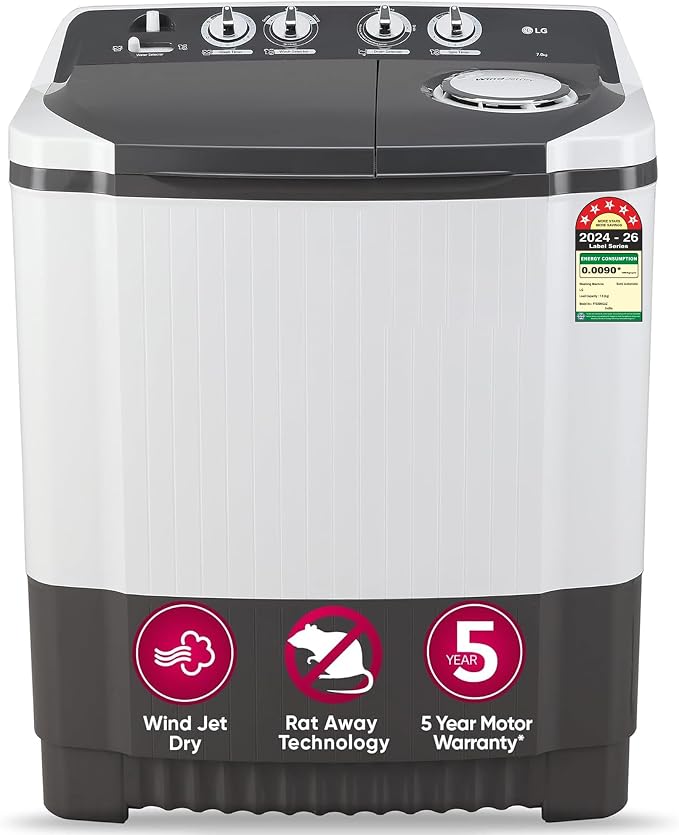
LG 7 Kg 5 Star Wind Jet Dry Semi-Automatic Top Loading Washing Machine (P7020NGAZ)
Rating: 4.4 out of 5 · 8,379 ratings
₹11,990 ₹16,990 (29% off)
Wind Jet Dry, Rat Away feature and roller jet pulsator — India’s highest-rated budget semi-auto.
8. Before you order: the hidden costs
- Installation is rarely included — budget ₹1,500–₹2,500 for bracket, piping and labour on a front-load or split setup.
- Confirm service-centre coverage in your PIN code before buying, not after.
- Measure doorways and the installation spot — a 9 kg front-load is deep and heavy.
- Use front-load-specific (low-suds) detergent in front-loaders; regular detergent over-suds and reduces cleaning.
- Run an empty hot cycle monthly to descale the drum and prevent odour.